
On August 12, with the grid‑connection and commissioning of the 1,038‑kW distributed photovoltaic (PV) project at Ningbo Science High School in Ningbo Qianwan New Area, Ningbo marked a landmark milestone in its new‑energy development: the city’s total installed distributed PV capacity exceeded 10 million kW, making it the first city nationwide to hit this 10‑million‑kW benchmark for distributed photovoltaic power.
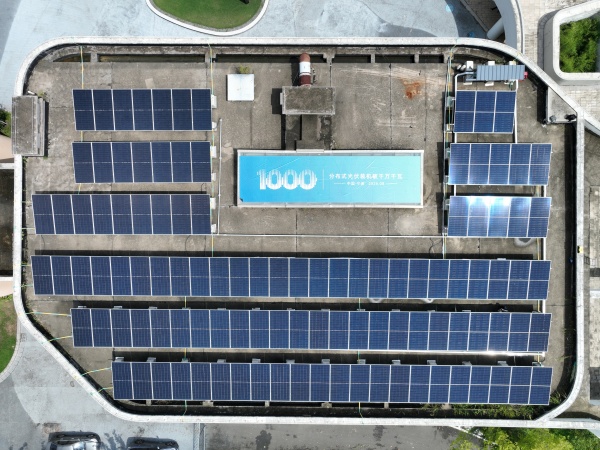
Aerial shot of the 1038 kW distributed photovoltaic project at Ningbo Science Middle School in Ningbo Qianwan New Area (photographed by Qi Chunchun)
Unlike the conventional large‑scale ground‑mounted power stations sprawling across the Gobi Desert in Northwest China, Ningbo, a major industrial hub, has blazed a distinctive development path. Its entire 10‑million‑kW distributed PV capacity is deployed on “fragmented” spaces including industrial parks, public‑building rooftops and residential roofs. Industrial parks account for as high as 84 percent of the total installed capacity, turning swathes of idle factory rooftops into miniature power plants.
At present, one out of every ten kilowatt‑hours consumed for production and daily life across Ningbo comes from sunlight. Based on an annual equivalent full‑load generation of 1,000 hours, these distributed PV systems can produce 10 billion kWh of clean electricity each year, cutting carbon‑dioxide emissions by roughly 5 million tons — equivalent to planting around 120 million trees.
For Ningbo, whose total social electricity consumption has ranked first in Zhejiang Province for six consecutive years, the roll‑out of this fragmented 10‑million‑kW PV fleet has strengthened the foundation for secure grid power supply, yet it has also brought about a “sweet headache”. Given solar power’s weather‑dependent nature, output can swing by up to 3 million kW between sunny and rainy days — a fluctuation comparable to starting or shutting down a large coal‑fired power plant. Challenges such as reverse overload in distribution networks, mismatched peak‑valley supply‑demand profiles, and complicated energy‑settlement procedures within industrial parks have emerged alongside. Faced with massive volumes of small‑scale, scattered distributed PV connecting to the grid at unprecedented speed and scale, State Grid Ningbo Power Supply Company has tackled this new‑energy challenge through dual advances in technology and services.
On the technical front, drawing on its Key Laboratory for Digital‑Physical Hybrid Simulation of New‑Type Power Systems, State Grid Ningbo Power Supply Company has built a county‑level full‑factor power‑grid planning‑simulation platform. It conducts end‑to‑end pre‑simulation before PV units are connected to the grid.
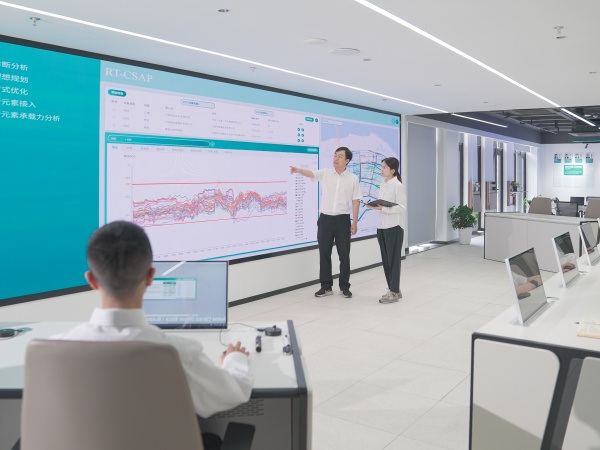
New Digital-Physical Hybrid Simulation Laboratory for Power Systems (Photographed by Qi Chunchun)
“The platform acts like a ‘sandbox’. We can run virtual tests to determine where and how distributed PV should be integrated, as well as its grid impacts, so as to identify optimal solutions and ensure clean solar power can be generated and delivered reliably,” explained Feng Yibin, Director of the Technology Innovation Office at the Economic‑Technology Research Institute of State Grid Ningbo Power Supply Company.
Boasting “four‑all” simulation capabilities: full‑factor, full‑voltage‑level, full‑link and city‑wide coverage, the platform leverages dedicated computing servers to deliver high‑precision calculations at the 50‑microsecond level — equal to performing 20,000 grid‑state simulations every second. More importantly, it can pre‑enact diverse extreme scenarios. For instance, it repeatedly simulates conditions of low electricity load paired with high PV output during the Spring‑Festival holiday, to pinpoint potential overload and over‑voltage risks and enable advance deployment and adjustment.
After completing pre‑emptive grid layout, the next challenge is to bring the randomness and volatility of photovoltaic generation under control. Relying on its “main‑grid, distribution‑grid and marketing” dispatching‑decision hub, State Grid Ningbo Power Supply Company has broken long‑standing data silos separating main‑grid operation, distribution‑grid management and marketing businesses. Grid‑operation logic has shifted from standalone grid regulation toward coordinated management of all types of adjustable energy resources across society. Teaming up with meteorological authorities, the company has developed a tailored electric‑power weather‑forecasting model, lifting the accuracy of new‑energy output forecasting to a stable 96 percent. City‑wide energy‑storage facilities, microgrids and industrial‑commercial flexible loads are integrated into the municipal virtual power plant, aggregating millions of kilowatts of adjustable resources. When cloud cover triggers sudden solar‑generation drops, energy‑storage charging‑discharging and load adjustment kick in within minutes to smooth out output volatility of new‑energy sources.
With these technical hurdles addressed, can clean energy flow unimpeded through distribution lines to end‑users and steadily lower electricity costs for the public? The answer is no. During specific periods such as mid‑sunny‑day peak PV generation or factory shutdowns with low power loads, local power‑generation output may far outstrip on‑site electricity demand. Surplus clean power that cannot be consumed locally flows backward from user sides into the grid. This gives rise to voltage rise and short‑term line overload, which may damage electrical equipment in severe cases, constrain normal PV output, and trigger local green‑power idling and solar curtailment.
These invisible power‑flow anomalies can be fully captured and efficiently resolved by China’s first practical “distributed‑PV operation‑monitoring application”. On its interface, interwoven red and green lines denote distinct power‑flow directions: green lines represent forward power flow from the grid to end‑users, while red lines indicate reverse power flow as surplus PV electricity feeds back into the grid. Grid dispatchers can instantly read power‑flow directions on every circuit. Once anomalies are detected, dispatchers can remotely operate intelligent switches on distribution lines via distribution‑automation systems, rapidly reroute surplus local PV power to areas with sufficient power load, dynamically balance power supply and demand across the grid, and boost local consumption of photovoltaic power.
While technical bottlenecks are being resolved, innovative service upgrades are moving forward in parallel. On the service side, State Grid Ningbo Power Supply Company has rolled out an integrated “power‑energy‑carbon” service model for industrial parks. It streamlines three major workstreams: grid‑connection access, energy‑efficiency improvement and carbon management, forming a full‑lifecycle comprehensive energy‑service system covering planning, construction and operation for park‑based enterprises.
Previously, park enterprises had to consult multiple separate institutions for services ranging from grid‑connection application, energy‑efficiency diagnostics and energy‑saving retrofits to carbon‑footprint accounting, green‑electricity and green‑certificate procurement — a cumbersome and time‑consuming process. Today, enterprises only need to engage one dedicated team for all these procedures. Energy facilities go into operation synchronously upon factory‑building completion, realizing “ready‑for‑move‑in occupancy with immediate access to services”.
Rooftop PV panels bring revenue‑accounting headaches for park enterprises. “Tariff policies keep changing. We can only read data from the main electricity meter, without knowing who consumes the on‑site generated green power or how cost savings should be shared,” said Jin Cheng, Person‑in‑Charge of Fengzheng Intelligent Manufacturing Park, voicing a pain‑point shared by many enterprises.
To tackle this issue, the digital “Sunshine Steward” settlement platform has been developed. Equipped with smart meters instead of manual meter‑reading, the platform enables itemized metering of energy‑use data and online centralized meter reading. Users gain real‑time access to detailed data including main‑meter and sub‑meter readings, electricity prices and electricity bills. Built‑in links with banking systems support end‑to‑end online processing of metering, settlement and automatic invoicing. It cuts the PV‑settlement cycle for industrial parks from 45 days to merely three days. To date, the platform serves more than 18,600 enterprises and industrial parks across Zhejiang Province, with total settled funds reaching RMB 140.62 billion.
As China’s No. 1 city for distributed photovoltaic capacity, hitting the 10‑million‑kW mark constitutes a landmark milestone for Ningbo’s green transition, as well as a brand‑new starting point. Embarking on the 15th Five‑Year Plan for energy low‑carbon development, Ningbo will steer its photovoltaic‑industry development from capacity expansion toward quality‑and‑efficiency improvement. It will keep innovating diversified models to expand green‑power consumption pathways, deploy cutting‑edge application scenarios covering energy storage, hydrogen energy and computing power, explore market‑oriented trading mechanisms, and deepen the integrated development of multi‑form green‑power businesses, building a Ningbo model for delivering China’s “Dual‑Carbon” goals.
版权及免责声明:凡本网所属版权作品,转载时须获得授权并注明来源“欧洲侨报”,违者本网将保留追究其相关法律责任的权力。凡转载文章,不代表本网观点和立场。版权事宜请联系:0040-751021899。
 时政新闻眼丨从四个维度读懂今年以来中国元首外交
版权所有:欧洲侨报苏ICP备17070786号-1
